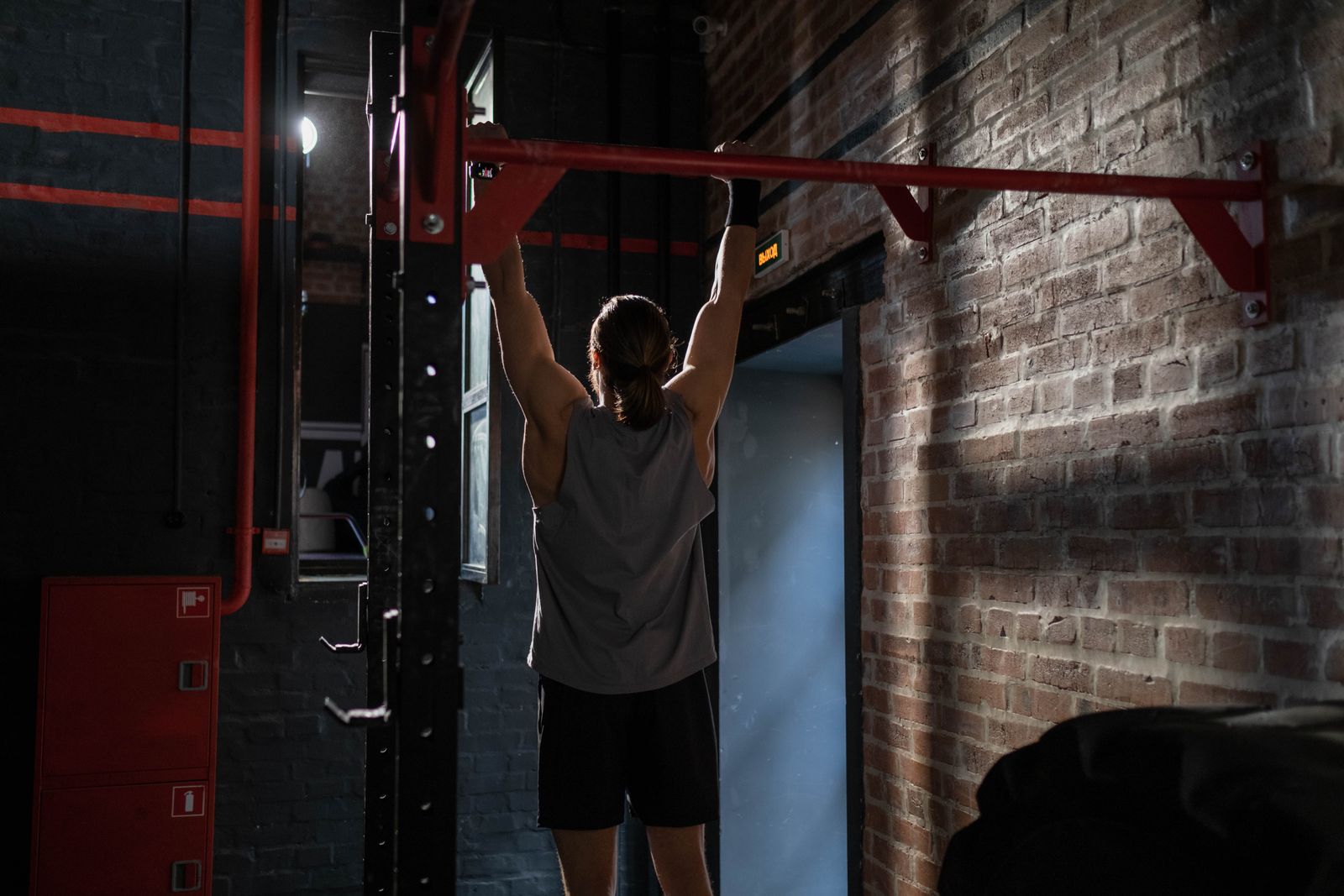
Why the Pull-Up Matters
The pull-up is among the most revealing tests of upper-body strength and muscular endurance. Unlike bench pressing or leg pressing, a pull-up offers no mechanical advantage—only the weight of the body and the capability of the back, shoulders, and arms to move it. It is employed in military fitness standards, athletic training protocols, and law-enforcement assessments precisely because it measures real, uncompromised strength.
A man who cannot do a single pull-up is not, by any strict measure, physically weak. A man who deliberately does not attempt to fix that gap is choosing not to pursue a baseline of upper-body competence. The progression is not mysterious. It demands specificity, patience, and weekly consistency—not novelty or heroic effort.
This article maps the path from zero pull-ups to one, then to multiple reps. It is built on research from the American Council on Exercise (ACE), the National Strength and Conditioning Association (NSCA), and peer-reviewed studies on grip strength, scapular mechanics, and training progression. It assumes no current pull-up capability and traces the work through common obstacles.
The pull-up is among the most revealing tests of upper-body strength and muscular endurance. Unlike bench pressing or leg pressing, a pull-up offers no mechanical advantage—only the weight of the body and the capability of the back, shoulders, and arms to move it.
The Dead Hang: The Foundation
Before pulling, grip and hold. The dead hang—hanging from the bar with straight or slightly bent arms—is the bedrock. Most men who cannot do a pull-up have spent zero time in a dead hang. The grip strength, shoulder stability, and positional awareness developed in the dead hang transfer directly to the pull-up.
How to execute: Grasp the pull-up bar with hands roughly shoulder-width apart, palms facing away from your body (overhand or pronated grip, which targets the lats effectively). Jump or step up and hang with arms extended, shoulders packed (slightly drawn down and back, not shrugged to the ears). The scapula—shoulder blade—should be in retraction, meaning actively held in position, not passively hanging from the shoulder socket.
Research on scapular mechanics shows that front pull-ups with controlled scapular positioning reduce impingement risk and build the foundational muscle activation pattern. Wide-grip and reverse-grip pull-ups create greater internal rotation and abduction, increasing shoulder impingement risk, especially for those early in a progression.
Target: Achieve a 30-second dead hang with packed shoulders. Progress to 45 seconds, then 60 seconds. Once a man can comfortably hold a 60-second dead hang, the nervous system is acclimated to the loaded position and ready for pulling work. This typically takes 2–3 weeks of three sessions per week.
Scapular Pulls: Activation Without Full Pulling
Before attempting to bend the elbows and pull the body, practice the scapular pull—a micro-pull that uses only the scapula. While hanging in the dead hang position, depress the scapula (draw the shoulder blades down and back) just 1–2 inches, then release back to neutral. Do not bend the elbows. This is purely scapular retraction and depression.
The purpose is to activate the lats (latissimus dorsi) and upper back without the demand of lifting significant body weight. Research on lat activation during pulling movements confirms that scapular positioning is the first phase of force generation. A man who cannot activate the scapulae cannot effectively activate the lats. The scapular pull teaches the nervous system which muscles do the work and cues their engagement.
Target: Perform 5–10 scapular pulls per set, three sets per session. The motion should be small and controlled. As proficiency grows, hold each depression for 1–2 seconds before releasing. Do this twice per week, on non-consecutive days. After 1–2 weeks, the scapular positioning becomes automatic, and the body is primed for band-assisted pulls.
Band-Assisted Pull-Ups: Reducing the Load
A thick resistance band looped over the bar and under the feet (or knees, depending on band strength) reduces the effective body weight during the pull. Unlike an assisted machine, a band provides variable resistance—more assistance at the bottom of the movement (where the band is most stretched) and less at the top (where it is relaxed). This forces the body to balance throughout and engages stabilizer muscles.
According to research on pull-up training progression, proper progression requires targeted training. The research found that when combined with consistent pull-up work, specific supplemental training significantly improved performance—forearm-specific training yielded a 222.5% increase in repetitions over eight weeks, core training 140.7%, and interval training 62.8%.
Band selection matters: A light band (typically colored red or blue) reduces body weight by approximately 20–50 pounds. A heavy band (green, usually) reduces by 50–100 pounds or more. Start with a band that allows 4–6 assisted pull-ups per set with good form. The goal is not to breeze through reps; it is to accumulate volume with proper scapular activation and a full range of motion.
Target: Perform 3 sets of 4–6 assisted pull-ups, twice per week on non-consecutive days. Lower with control (3–4 seconds), pausing at the bottom with scapulae retracted. As weeks progress, either increase reps (aiming for 6–8 per set) or downgrade to a lighter band, reducing assistance.
Grip strength emerged as a critical limiting factor in pull-up execution. Many men who cannot complete a pull-up are not failing due to lat strength; they are failing because grip fatigue arrives before the lats are fully taxed.
Negative (Eccentric) Pull-Ups: Building Strength at the Top
A negative pull-up uses no assistance on the descent. Climb or jump to the top of the pull-up bar (chin above the bar), then lower yourself as slowly as possible—aiming for 3–5 seconds of descent—until arms are fully extended. The eccentric (lowering) phase builds tremendous strength because muscle can control more load during lengthening than during shortening.
This phase bridges the gap between assisted and strict pull-ups. A man who can control a 5-second negative is developing the strength needed for the full pull-up. Research shows that eccentric training produces faster strength gains than concentric training alone, making negatives an essential component of the progression.
Execution: Jump or use a small step to reach the top position, chin above the bar. Grip the bar with hands shoulder-width apart, elbows tucked slightly in front of the body. Begin the descent by first depressing (lowering) the scapulae, then slowly bending the elbows, controlling the descent all the way to an extended-arm dead hang. Do not drop suddenly at the bottom.
Target: Perform 3–5 negative pull-ups per set, two sets per session, twice per week. As control improves, increase the duration of each negative from 3 seconds to 4, then 5 seconds. Once a man can execute five 5-second negatives with strict form, he is ready to attempt the full pull-up.
Grip Strength: The Limiting Factor
Many men who cannot complete a pull-up are not failing due to lat strength or back development. They are failing because grip fatigue arrives before the lats are fully taxed. When the fingers relax and the grip slips, the pull-up ends—regardless of how much back strength remains.
A comparative study on pull-up training found that forearm-specific training—focused on wrist flexors and extensors—delivered the highest performance gains. Strengthening the forearms delays grip fatigue, allowing the prime movers (back, shoulders) to fully engage and adapt. Grip strength improved by 12–14% in the forearm-trained group over eight weeks, while other groups showed minimal improvement.
Include grip work twice per week: Dead hangs (as noted above), farmer's carries (holding heavy dumbbells at your sides and walking), and wrist flexion/extension work with a light dumbbell. Hold the dumbbell with the forearm resting on a bench or table, letting the weight drop toward the palm (flexion), then lift the knuckles upward (extension). Perform 2 sets of 15 reps on each movement.
Grip width also influences performance. Research on lat pull-downs—a similar movement—shows that narrow to medium grips (1 to 1.5 times shoulder width) produce greater strength than wide grips, while muscle activation remains similar across widths. For the pull-up, grip the bar roughly shoulder-width apart or slightly narrower. Elbows should point roughly 45 degrees inward, hugging the ribcage.
The Strict Pull-Up: First Rep and Beyond
Once a man can perform five 5-second negative pull-ups and hold a 60-second dead hang with scapular control, the first strict pull-up is within reach. A strict pull-up is a full-range pull—from a dead hang with straight arms to chin above the bar—performed without momentum, assistance, or kipping (the swing used in CrossFit).
Attempt the pull-up at the start of the session, when the nervous system is fresh. Jump to the bar or use a small step to set hands and position. Initiate the pull by depressing the scapulae first—this activates the lats before bending the elbows. Pull the elbows down and slightly back, driving the chest toward the bar. The chin should pass over the top of the bar. Lower with control.
If the first rep doesn't come, that's not failure. Return to one more week of negatives and band-assisted work. Strength is not linear day to day; it accumulates over weeks. Once one rep is achieved, the immediate goal is two. After two reps are consistent, progress to three. Do not attempt high rep sets early on. Build the foundation with low reps, high quality, high frequency.
A weekly schedule that works: Pull-ups (strict or assisted) on Monday and Thursday. Negatives or band work on Tuesday and Friday. Grip and scapular activation work (farmer carries, dead hangs, wrist flexion) on all four days. Rest Wednesday, Saturday, Sunday. This frequency allows recovery while maintaining weekly pulling volume.
Weekly Progression Plan: 0 to 5+ Pull-Ups
The table below outlines a conservative 12-week progression, assuming starting from zero pull-up capability. The timeline is not aggressive; it allows adaptation and eliminates the common pattern of early enthusiasm followed by injury or burnout.
Progression happens in two ways: increasing reps per set, or decreasing assistance. Do not jump both simultaneously. When band-assisted pull-ups reach 6–8 per set, downgrade the band. When negative pull-ups reach five 5-second reps consistently, attempt the strict pull-up. When strict reps accumulate, add a second strict rep before adding volume to the set.
Plateaus are normal. If progress stalls for two weeks, add a second set of negatives on a third day per week, or increase grip work volume. Soreness in the elbows or shoulders signals poor form or excessive volume—reduce volume, check form, and consult a physical therapist if pain persists.
Recovery matters. Adequate sleep, protein intake (minimum 0.7 grams per pound of body weight daily), and caloric balance support adaptation. A man in a severe caloric deficit will struggle with pull-up progression. Strength adaptation requires positive energy balance or maintenance calories; do not attempt this progression while losing weight aggressively.