Why Core Strength Matters (and It's Not About Appearance)
The core is not the abs. The rectus abdominis—the muscle responsible for the six-pack look—is only one piece of a complex system that includes the transverse abdominis, internal and external obliques, erector spinae, and quadratus lumborum. Together, these muscles form a cylinder that stabilizes the spine, braces for load, and maintains posture during compound movements. A weak core doesn't just limit athletic performance; it increases injury risk and accelerates spinal degeneration.
According to the American Council on Exercise (ACE), core stability deficits are linked to chronic lower back pain, one of the most common complaints among men. The National Strength and Conditioning Association (NSCA) emphasizes that functional core training—exercises that resist movement rather than create it—provides better protection than traditional crunches. A meta-analysis in the Journal of Strength and Conditioning Research found that anti-rotation exercises and carries produced greater gains in functional strength and stability than isolating the rectus abdominis.
The practical reason: when you deadlift, carry groceries, or bend to pick something up, your core's job is to prevent movement, not to perform movement. Training that reality is what builds a core that protects your back and transfers force through your body.
The core is not the abs. It is a complex system of deep stabilizers whose job is to prevent movement, not perform it.
Anti-Extension and Anti-Rotation: The Framework
Most core exercises fall into two categories: anti-extension (resisting forward bending) and anti-rotation (resisting twisting). This framework matters because it matches how your core actually works in real life.
Anti-extension exercises teach your core to hold the spine in a neutral position under load. The primary movers are the deep transverse abdominis and the obliques, which create intra-abdominal pressure. When you resist extension—prevent the lower back from arching—you're training the most functional position for heavy lifting and loaded movement.
Anti-rotation exercises train the obliques and deep stabilizers to prevent the spine from rotating under load. According to research from the Mayo Clinic, anti-rotation work correlates more closely with injury prevention and functional capacity than traditional trunk curls. The reason is that rotational demands are constant in sport and daily life—from throwing to turning in your chair to stepping sideways under load.
The Dead Bug: Anti-Extension Foundation
Start with the dead bug, a humble but essential anti-extension drill. Lie on your back, raise both arms straight up, and raise both knees to 90 degrees (hips and knees bent). The movement is simple: extend one leg straight out, lowering it until it's nearly touching the floor, while simultaneously extending the opposite arm overhead. Return to the starting position and alternate sides.
The dead bug teaches core tension with the spine in a neutral, non-threatening position. Harvard Health notes that dead bugs are especially valuable for building stability without load, making them ideal for warm-ups or for anyone returning from back injury. The key cue is to keep the lower back glued to the floor throughout; if it arches, your core is not engaged or the range is too ambitious.
Perform 3 sets of 10–12 reps per side, slowly. The dead bug is not a race. The benefit comes from sustained tension and the neuro-muscular learning of keeping the spine stable while limbs move.
The Plank: The Anti-Extension Standard
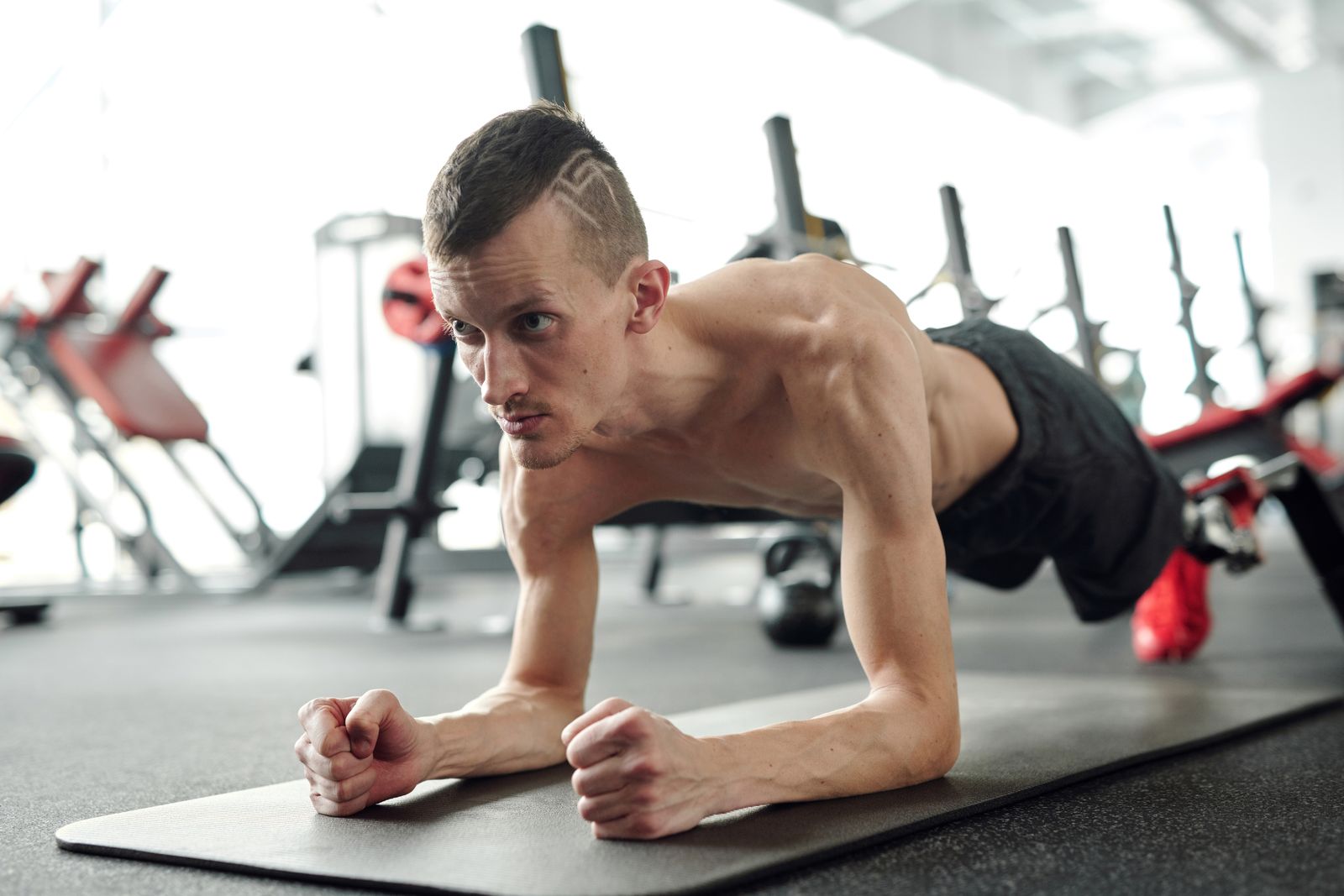
The plank is the most recognizable core exercise, and for good reason: it produces measurable anti-extension strength when performed correctly. Start face-down, elbows under shoulders, feet hip-width apart. Engage the core, glutes, and quads to create a straight line from head to heels. Do not let the hips sag.
Common mistakes break the exercise. A sagging plank puts the lower back in extension and trains the wrong pattern. Many practitioners also hold their breath, which reduces intra-abdominal pressure and defeats the purpose. The cue is to brace the core as if bracing for a punch, then breathe continuously and slowly throughout.
Start with 3 sets of 30–45 seconds, rest 60 seconds between sets. Once you can hold 60 seconds without form breakdown, add load by placing a light weight plate on your back. The American Council on Exercise emphasizes progressive overload even in planks: adding weight is more effective for strength gains than endless static holds.
The Pallof Press: Anti-Rotation Gold Standard
The Pallof press is the single best anti-rotation exercise. Using a cable machine or resistance band anchored at chest height, stand perpendicular to the anchor point with your feet shoulder-width apart. Hold the handle at your chest with both hands, core braced. Press the handle straight out in front of you. The resistance pulls you toward rotation; your core resists that pull.
The critical detail is that you're not trying to rotate; you're trying not to rotate. The obliques and deep stabilizers prevent the shoulders from turning toward the cable. The National Strength and Conditioning Association identifies the Pallof press as a cornerstone anti-rotation movement for athletes and general populations alike, because it addresses real-world demands: carrying something uneven, fighting off a push, or maintaining posture under asymmetrical load.
Perform 3 sets of 10–15 reps per side using a weight that forces you to fight the pull hard but still maintain alignment. Progress by adding weight, not by increasing reps. The moment form breaks—shoulders rotate or trunk bends—the set is over.
Repeated spinal flexion under load accelerates disc degeneration. Anti-extension and anti-rotation exercises build stronger, more stable cores with less injury risk.
Hanging Leg Raise and Its Role
The hanging leg raise is not a core exercise in the modern sense. It primarily works the hip flexors (iliopsoas) and secondarily the lower rectus abdominis. Many trainers include it, and it does build raw strength—especially the lower abdomen—but it is not anti-extension or anti-rotation work.
The advantage of the hanging leg raise is that it provides significant load under gravity, which builds absolute strength in the abdomen and hip flexors. If your goal is visible ab musculature and raw core power, it is worth including, but not as your primary core work.
A practical programming note: perform hanging leg raises after your main strength work, not before. Hanging work fatigues the grip and forearms, which limits deadlift, rowing, and other key movements. Perform 3 sets of 8–12 reps. For beginners, bend the knees and raise the knees toward the chest instead of extending fully.
Loaded Carries: The Forgotten Core Movement
Loaded carries—farmer's carries, suitcase carries, waiter walks, or yoke carries—are the most functional core training available. They demand continuous bracing, teach the core to stabilize under load, and build grip strength simultaneously.
A farmer's carry is simplest: hold a heavy dumbbell or kettlebell in each hand and walk. The core resists forward bending from the load. A suitcase carry uses a single unbalanced load (one heavy dumbbell), forcing the obliques to resist lateral bending. Harvard Health and the American Council on Exercise both cite carries as essential for functional core strength and real-world stability. The reason: there is no equipment, no setup, and immediate transfer to daily tasks like carrying groceries or a suitcase.
Program carries at the end of your core session, or as a standalone finisher twice weekly. Walk 30–50 meters with a weight you can control—grip and core fully engaged—rest 2 minutes, and repeat for 3–5 sets. Progress by adding weight, not distance. A 100-pound farmer's carry for 50 meters builds more core strength than a light 200-meter walk.
Why Crunches and Sit-ups Are Overrated
Crunches and sit-ups perform spinal flexion—they shorten the distance between the ribs and pelvis. They do activate the rectus abdominis, but they also place repeated stress on the spine in the exact position where most back pain occurs: forward bending. According to the CDC and OSHA ergonomics guidance, repeated spinal flexion under load accelerates disc degeneration and ligament stress.
The research is clear: anti-extension and anti-rotation exercises build stronger, more stable cores than flexion-based work, with less injury risk. If a visible six-pack is your goal, that is a nutrition problem (addressed below), not an exercise problem. The aesthetics follow from building the underlying muscle through functional strength training.
This does not mean crunches are forbidden. A trained athlete can include them in moderation. But they should never be the foundation of core training, and they should never come before heavier, more functional work.
The Kitchen Reality: Abs Are Made in Nutrition, Not the Gym
No amount of core exercise creates visible abs if they are buried under body fat. The rectus abdominis and obliques must be exposed through a caloric deficit, which means eating less than you burn. According to research in the American Journal of Clinical Nutrition, visible abdominal musculature typically appears around 10–12% body fat in men.
Building a visible midsection requires two steps: (1) Build core and ab musculature through the strength exercises above, and (2) Cut calories to expose what you have built. The order matters. Too often, men try to out-crunch a poor diet, which wastes time and teaches the wrong movement pattern.
Practically: eat at a modest deficit (300–500 calories below maintenance), maintain protein intake (0.8–1g per pound of body weight), and include resistance training and core work to preserve muscle during the deficit. The deficit, combined with consistent strength training, produces the look. The crunches do not.