Why Men Neglect Leg Day (and Why That Costs Them)
Upper-body exercises dominate most gym floors. According to workout data analysis, bench press ranks as the single most popular exercise, with two of the top ten exercises involving the upper body for every one lower-body movement. The reasons are predictable: chest and arms are visible in a t-shirt; leg strength is invisible under jeans. This preference creates a measurable gap. Research from Tonal's State of Strength report found that men's upper-body strength exceeds lower-body strength by an average of 34%, while women maintain only an 8% gap between the two.
Beyond vanity metrics, this imbalance carries real costs. Leg strength directly impacts fall prevention, especially as men age. Nearly one in four adults over 65 fall annually, and falls remain the leading cause of nonfatal trauma and injury-related disability in that population. Additionally, men begin losing muscle mass after age 30, with an accelerated decline after 60—and the glutes may deteriorate faster than surrounding muscles, making targeted leg work essential for maintaining functional capacity in your 40s, 50s, and beyond.
The physiology of lower-body training also benefits systemic health. Free-weight compound movements like squats engage large muscle groups and trigger meaningful hormonal responses. While squats don't possess 'magical' testosterone effects, research comparing squats to leg press found that barbell squats produced larger acute boosts in both testosterone and growth hormone compared to machine work. More importantly, these compound movements build and preserve muscle mass, which declines at 3–5% per decade after age 30 and can be significantly slowed through resistance training.
Men's upper-body strength exceeds lower-body strength by an average of 34%, while women maintain only an 8% gap—evidence of a systemic neglect of lower-body training.
The Foundational Leg Day Pattern: Five Movement Categories
An effective leg day doesn't require exhaustive exercise selection. Rather, it covers five key movement patterns that address the entire lower body systematically. Each category can be executed with multiple exercise variations, but the pattern itself remains consistent.
**Squat Pattern (Quad-Dominant Knee Flexion).** The barbell back squat, goblet squat, or leg press achieves deep hip and knee flexion while maintaining a relatively upright torso. This movement pattern emphasizes the quadriceps and demands stability through the core and ankles.
**Hinge Pattern (Hip-Dominant Hip Extension).** The deadlift and Romanian deadlift (RDL) train the posterior chain—glutes, hamstrings, and lower back—through hip flexion and extension while the knees remain mostly straight. The RDL in particular teaches athletes to load the hips properly, a skill fundamental to everything from picking up a heavy object to athletic movement.
**Lunge or Split-Stance Pattern.** Bulgarian split squats, forward lunges, or reverse lunges build single-leg strength and stability while addressing strength imbalances. This unilateral work also engages the core and requires proprioceptive control.
**Calf Pattern (Ankle Plantarflexion).** Standing and seated calf raises address the gastrocnemius and soleus separately, building ankle stability and calf musculature often neglected in compound work.
**Accessory Quad or Posterior Chain Work (Optional).** Leg curls or leg extensions can supplement main movement patterns if a specific weakness exists, though they aren't required in every session.
Squat Pattern: Building Strength and Stability
The barbell back squat stands as one of the most researched and effective lower-body movements. According to ACSM's 2026 resistance training guidelines, compound movements like squats should be prioritized, with emphasis on controlled eccentric (lowering) phases over 2–3 seconds.
**Form Cues for the Back Squat.** Position feet shoulder-width apart with toes slightly outward (10 degrees). Place the bar across the rear deltoids and upper back, never resting on the neck. Engage the core, keep your chest upright, and descend by simultaneously bending hips and knees. A common error is allowing knees to collapse inward; keep them tracking over your toes. Descend to parallel (where the hip crease drops below knee level) or below if mobility permits. Drive through the entire foot (not just the heel) on the ascent, maintaining an upright posture throughout.
**Programming for the Squat.** For general strength and hypertrophy, perform 3–4 sets of 6–10 reps using 75–85% of your one-rep max. If your 1RM squat is 315 pounds, that means 235–270 pounds for working sets. Rest 2–3 minutes between sets to allow full recovery. According to Harvard Health research, heavier weights with lower reps (8 reps for 3 sets) produce stronger hypertrophy than lighter loads with many reps.
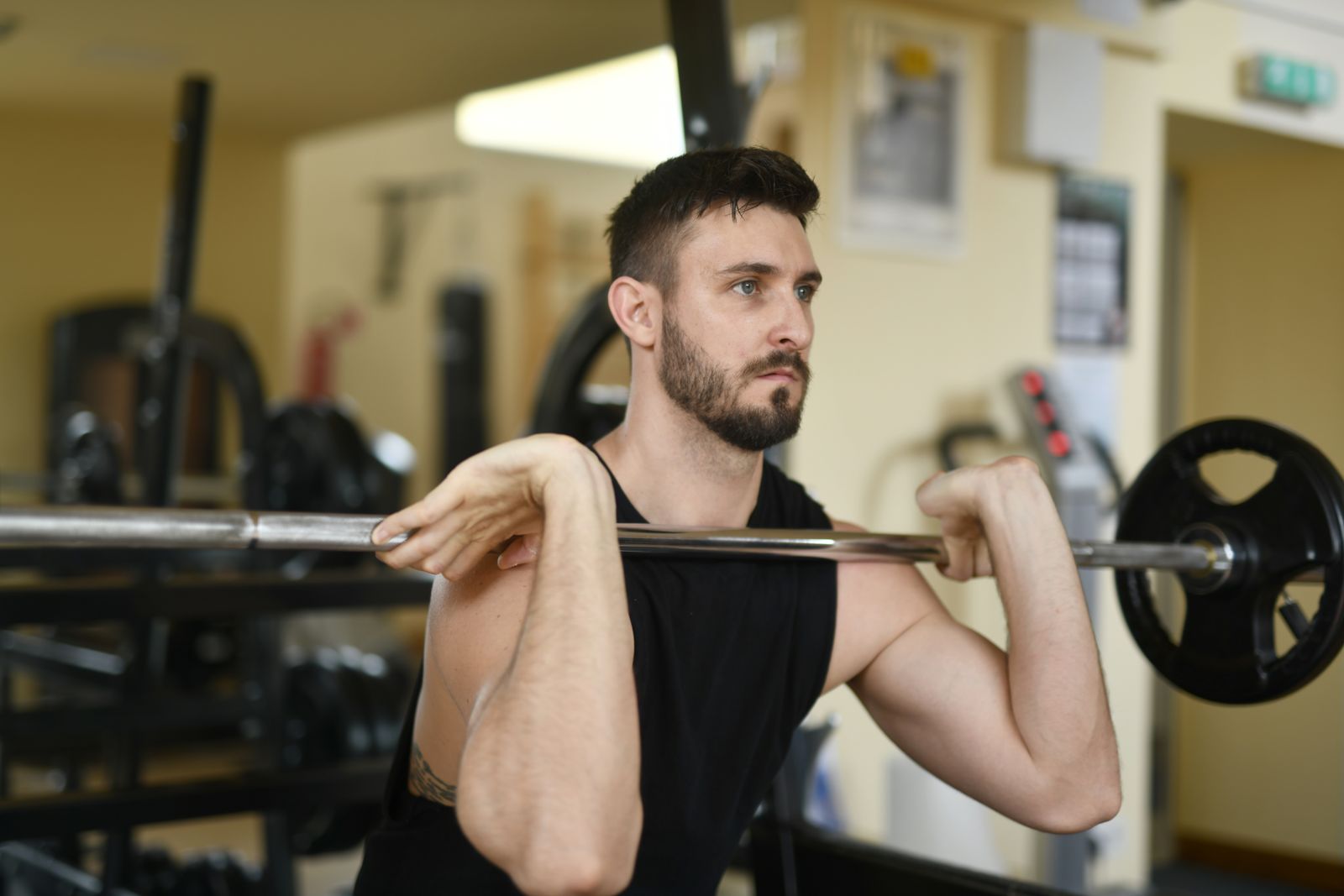
**Squat Variations.** The goblet squat (holding a dumbbell or kettlebell at chest height) is an excellent entry point that self-corrects form and builds movement quality. The leg press provides similar loading with reduced technical demand and is appropriate for athletes recovering from injury. Front squats, where the bar rests on the front deltoids, shift emphasis toward the quads and demand less lower-back stability.
Hinge Pattern: Mastering the Deadlift and Romanian Deadlift
The deadlift and its variations represent the single most effective movement for posterior-chain development. Unlike the squat, the hinge is hip-dominant: the movement occurs primarily at the hips while knees remain mostly straight.
**Form Cues for the Conventional Deadlift.** Begin with feet hip-width apart, shins touching the bar. Grip the bar with a shoulder-width grip (overhand, mixed, or hook grip). Flatten your back, depress your shoulders, and ensure your hips sit higher than your knees at the start. Drive through the entire foot and extend the hips first—the bar should travel up your legs in a nearly vertical path. Common errors include allowing the hips to rise too early (turning a deadlift into a back-dominant squat) or rounding the lower back under load. Maintain spinal neutrality throughout; the cue 'chest up, hips down' helps enforce this.
**Form Cues for the Romanian Deadlift (RDL).** The RDL is hip-hinge dominant. Begin standing tall with light dumbbells at hip height or an empty barbell. Maintain a slight knee bend (do not increase it during the movement). Push your hips backward—not down—as if closing a car door with your glutes. Feel a stretch in the hamstrings as you descend to about shin level. Drive the hips forward to stand upright. The RDL teaches the hip hinge pattern better than any other movement and is less technical than the deadlift, making it an excellent starting point for beginners.
**Programming the Hinge.** Perform the deadlift or conventional hinge variation for 3 sets of 4–6 heavy reps (80–90% of 1RM) once per week. The RDL is less neurologically demanding and can be programmed more frequently: 3–4 sets of 6–10 reps, 2–3 times per week. According to research cited in the NSCA's Guide to Program Design, the basic strength phase for hinges involves 80–95% of 1RM with 2–6 reps per set.
Barbell squats produce larger acute boosts in both testosterone and growth hormone compared to machine work, while building and preserving muscle mass that declines at 3–5% per decade after age 30.
Lunge and Split-Stance Patterns: Building Single-Leg Strength
While bilateral movements (squats, deadlifts) form the core of leg day, unilateral or split-stance work addresses strength imbalances and builds stability crucial for athletic movement and injury prevention.
**Bulgarian Split Squat.** The Bulgarian split squat rivals the squat for hypertrophy stimulus while loading each leg independently. Stand approximately 2 feet in front of a bench or box at knee height. Place your rear foot on the bench (top of foot) and step your front foot forward enough that your front knee remains over your ankle at the bottom. Lower by bending your front knee, keeping your torso upright. Research shows Bulgarian split squats produce 15–20% greater glute activation than forward lunges due to the rear-foot elevation, making this variation ideal for maximizing posterior-chain development. Perform 3 sets of 8–12 reps per leg, resting 90–120 seconds between sets.
**Forward Lunges.** Step forward, lower your body until your rear knee nearly touches the ground, then drive through your front heel to return. Unlike the Bulgarian variation, forward lunges demand greater dynamic balance and core stabilization. They excel for functional strength and proprioceptive training. Perform 3 sets of 10–15 reps per leg with lighter loads than the Bulgarian variation.
**Reverse Lunges.** A safer variation than forward lunges for those with knee pain or balance issues. Step backward rather than forward, achieving the same loading stimulus with reduced anterior knee stress. Perform 3 sets of 8–12 reps per leg.
Calf Development and Training Volume
The calves—composed of two muscles, the gastrocnemius (outer calf) and soleus (deeper muscle beneath)—are often neglected in leg day, yet deserve specific attention. Standing calf raises emphasize the gastrocnemius, while seated calf raises shift stimulus to the soleus due to the differences in their length at various knee angles.
**Standing Calf Raises.** Perform this exercise with a barbell across your shoulders, in a calf-raise machine, or holding dumbbells. Rise up onto your toes, pause briefly at the top, then lower with control. The stretch at the bottom is crucial for hypertrophy. Perform 3–5 sets of 8–15 reps.
**Seated Calf Raises.** Sit on a calf-raise machine or bench with a weight on your knees. Rise onto your toes. This variation, with the knee bent, isolates the soleus effectively. Perform 2–3 sets of 12–20 reps.
**Training Volume.** Calves respond well to high volume and frequency. According to research, intermediate lifters should aim for 12–20 total calf-raise sets per week, spread across 2–3 sessions, since the calves recover quickly and adapt to training stimulus. Advanced lifters benefit from 15–25 sets weekly.
Putting It Together: A Complete Leg Day Protocol
A complete leg day session takes 45–60 minutes and addresses all movement patterns with proper loading and recovery. Here is a template adapted for strength and size development:
**Warm-Up (5 minutes).** 10 air squats, 10 bodyweight hip hinges, 10 reverse lunges per leg, 20 calf raises.
**Main Strength Block (30 minutes).**
1. Back Squat or Goblet Squat: 4 sets of 6–8 reps at 80–85% 1RM. Rest 2–3 minutes.
2. Deadlift or Romanian Deadlift: 4 sets of 4–6 reps at 80–85% 1RM (deadlift) or 6–8 reps at 70–75% 1RM (RDL). Rest 2–3 minutes.
**Supplemental/Hypertrophy Block (15 minutes).**
3. Bulgarian Split Squat: 3 sets of 10–12 reps per leg. Rest 90 seconds.
4. Standing Calf Raises: 3 sets of 12–15 reps. Rest 60 seconds.
5. Seated Calf Raises: 2 sets of 15–20 reps. Rest 60 seconds.
**Frequency.** Train legs once per week if performing this complete template, or split movements across two sessions (squats and hinges Monday; lunges and calves Thursday) if training twice weekly. According to ACSM guidelines, training each major muscle group at least twice weekly with 48 hours of recovery between sessions optimizes strength and hypertrophy development.
**Progressive Overload.** Increase load or reps every 2–4 weeks. If you completed 4 sets of 6 reps at 275 pounds on the squat, the next session might be 4 sets of 6 reps at 280 pounds, or 4 sets of 7 reps at 275 pounds. Small, consistent increases drive adaptation.
Common Mistakes and How to Avoid Them
**Insufficient Volume.** Many athletes perform only 2 sets of squats and call leg day complete. According to hypertrophy research, approximately 10 sets per muscle group per week produces optimal size gains. A single squat workout of 2 sets is insufficient. Distribute volume across multiple sets and exercises.
**Excessive Knee Flexion with Poor Ankle Mobility.** If your ankles lack dorsiflexion mobility (the ability to point your shin forward), your knees will cave inward during the squat descent. Spend 2–3 minutes before leg day performing ankle mobility work, such as banded ankle mobilizations or wall-supported dorsiflexion holds.
**Poor Eccentric Control.** Lowering the weight in one second and pressing up in three creates a suboptimal hypertrophy stimulus. Reverse the tempo: take 3 seconds to lower (eccentric phase), pause briefly, and 1–2 seconds to press up. This tempo maximizes muscle time under tension.
**Ignoring the Posterior Chain.** Some programs overemphasize quad-dominant movements and neglect hip extension. Without sufficient deadlift or RDL volume, the glutes and hamstrings fall behind, creating muscular imbalances and increasing injury risk. Ensure hinges comprise at least 25–30% of leg-day volume.
**Training to Absolute Failure on Every Set.** While training close to failure (stopping 1–2 reps short of muscular failure) optimizes hypertrophy, training to absolute failure on every heavy compound set drains your nervous system and makes it difficult to maintain load and form on subsequent exercises. Reserve all-out effort for the final set of each movement.