The fifteen-minute version of the worst day
The order comes over the phone and the radio at the same time: mandatory evacuation, fire line two ridges over, power already cut to the neighborhood. There is no time to think, no time to shop, and the gas station three miles down is a parking lot. A man either walks out the door with a packed bag in fifteen minutes or he walks out with whatever he managed to grab in a panic.
A bug-out bag exists to make that decision boring. It is a single packed bag, staged and ready, that carries one person through roughly three days away from home with no resupply. Ready.gov and FEMA both frame the whole preparedness exercise around that 72-hour window, because that is the gap before organized help typically reaches a disrupted area.
A bug-out bag exists to make the worst decision of the year boring: grab the bag, walk out, the thinking was already done.
Bug-out bag, get-home bag, everyday carry
These three kits get conflated, and the differences are about distance and direction. A bug-out bag is built for leaving home and not coming back for several days. It assumes evacuation: wildfire, flood, hurricane, hazardous-materials spill, or any order to clear out. The destination is away.
A get-home bag is the mirror image. It lives in a vehicle or at the office and is sized to cover the trip from wherever a man is back to home, usually one stressful day on foot. It is lighter, more mobile, and short on shelter because the destination is a known roof.
Everyday carry is what stays on the body — a knife, a light, a phone, a way to make fire, cash. It is the kit that is always present because it is never set down. The bug-out bag is the largest and most complete of the three, and the only one organized around the full 72-hour standard.
The ten categories that fill the bag
Every credible packing list — Ready.gov's Build A Kit, the American Red Cross survival kit supplies, FEMA's emergency supply list, and the CDC's personal needs guidance — converges on the same core categories. Build the bag around all ten and nothing essential gets left out.
Water comes first because it is the heaviest and the most urgent. Ready.gov sets the standard at one gallon of water per person per day for drinking and sanitation. Three days is three gallons, and water weighs roughly 8.3 pounds per gallon, so 24 pounds of water alone is impractical to carry. The fix is to pack two to three liters of ready water plus a means of purification — a squeeze filter or purification tablets — so the bag stays light and still produces clean water from a stream or tap downstream.
Food should be calorie-dense and need no cooking: energy bars, nut butter, jerky, freeze-dried meals if a stove is included. The Red Cross recommends a three-day supply of non-perishable food. Shelter and warmth follow — an emergency bivy or mylar blanket, a poncho, a hat, gloves, and a dry change of socks. Hypothermia is a faster killer than hunger, which is why the Red Cross flags warmth as a top-tier item.
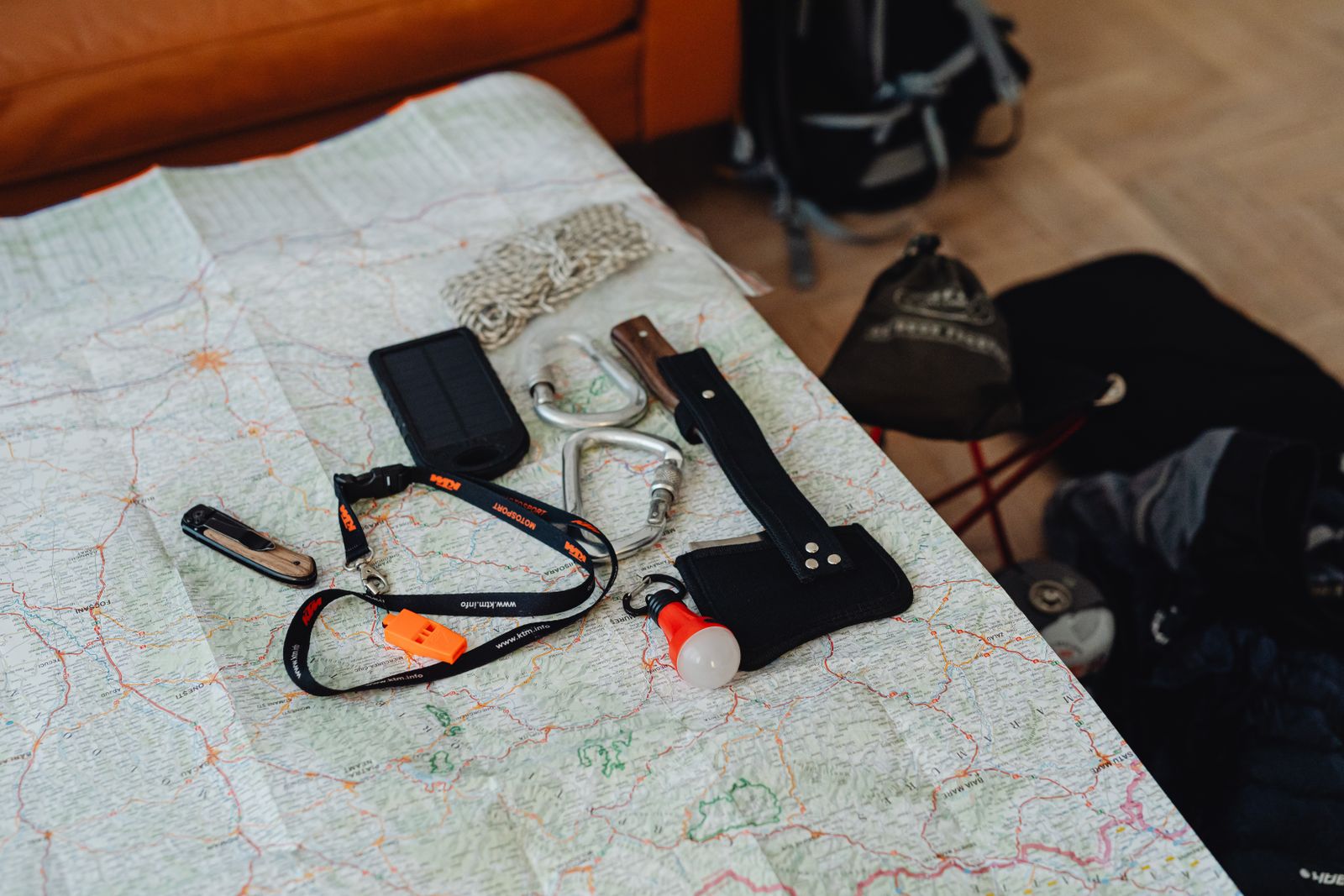
The rest of the categories round out the kit: fire (a lighter plus waterproof matches and a ferro rod), a first aid kit, basic tools (a multi-tool, duct tape, a manual can opener, paracord), light (a headlamp and a hand-crank or battery radio with spare batteries), communications and documents (a NOAA-capable radio, a printed contact list, copies of ID and insurance in a waterproof bag), cash in small bills for when card readers are down, and hygiene supplies (wet wipes, sanitizer, a toothbrush, any medications). The CDC stresses personal needs in particular — a 7-to-10-day supply of prescription medication, glasses, and items for children, seniors, or pets.
Water weighs 8.3 pounds a gallon, so the kit carries a filter, not three days of jugs. A bag too heavy to carry is a bag left at the curb.
How heavy, and in what order
Weight is the constraint that decides whether the bag gets carried or abandoned at the curb. A common rule of thumb caps a loaded pack at roughly 20 percent of bodyweight for sustained movement on foot. For a 180-pound man that is about 36 pounds; for a 200-pound man, about 40. Anything heavier turns a 72-hour kit into a back injury, and the first mile of an evacuation on foot is where overpacked bags get gutted.
Pack for both weight distribution and access. Heavy, dense items — water, food, tools — ride close to the spine and centered over the hips, where the body carries load most efficiently. Light, bulky items like the sleeping system and spare clothing fill the bottom and the outer pockets.
Then pack for the order a man actually needs things. First aid, the headlamp, a fire source, a water bottle, and the document pouch belong in the top lid or hip-belt pockets — reachable without dumping the whole bag in the dark. The principle is simple: the items needed fastest live nearest the opening, and the items needed rarely live deepest.
Where it lives and how to keep it alive
A bug-out bag is useless in a closet a man cannot reach in fifteen minutes. Stage it near the primary exit — a hall closet, a mudroom, the trunk of a daily-driven vehicle. The test is whether it can be grabbed on the way out the door without a detour.
A packed bag is not a finished bag, because half its contents expire, leak, or stop fitting. Ready.gov advises reviewing a kit at least once a year and updating it as needs change. Practically, that means checking water and food for expiration, swapping batteries, confirming medications are current, rotating the seasonal clothing layer between summer and winter, and re-verifying that the printed documents and emergency contacts still match reality.
Set the cadence and tie it to dates already on the calendar — twice a year at the daylight-saving clock changes is the classic anchor, the same weekend smoke-detector batteries get swapped. A kit checked every six months and topped off after every use is a kit that works on the one day it is needed.
Build it once, then leave it alone
The hard part of a bug-out bag is not the gear list — it is finishing the bag and then trusting it. The temptation is to keep raiding it for a camping trip or a road snack, which is exactly how a ready bag quietly becomes an empty one. Buy duplicates of the cheap consumables so the staged kit is never the one that gets borrowed.
Start with the ten categories, weigh the loaded pack, cut until it sits under 20 percent of bodyweight, and stage it by the door. The point of the whole exercise is that on the worst day, the thinking was already done — months earlier, in a calm kitchen, with a checklist and a scale instead of an evacuation order and a clock.