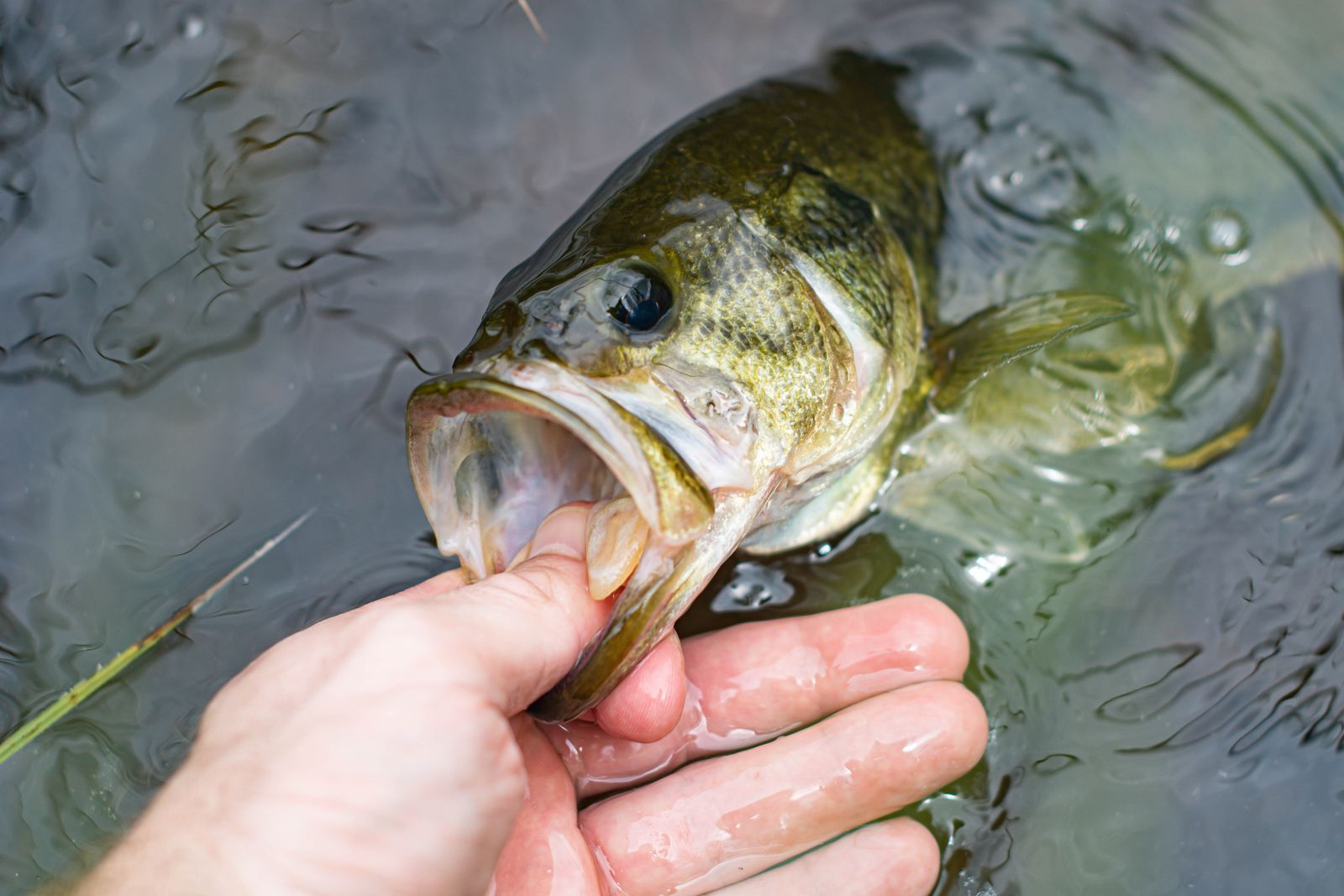
Why Largemouth Bass for Your First Fish
Largemouth bass are neither the easiest nor the most challenging freshwater fish to catch. They occupy a sweet spot: abundant enough that patience pays off, aggressive enough to reward solid fundamentals, and forgiving enough that small mistakes do not end your session. A largemouth is a solitary ambush predator, which means it does not move far from cover. Once you locate cover—weeds, logs, docks, sunken brush—you are fishing to bass. The predatory nature cuts both ways: if a bass sees a meal-sized bait near its lair, it will strike. Confidence follows.
A 6-foot to 6½-foot medium-power spinning rod with 8–10 lb monofilament line is the entry-level setup. Monofilament is cheap, forgiving, and easy to tie. Avoid braided or fluorocarbon lines until you have logged 20 days on the water; they mask mistakes and teach bad habits. Your rod should have a smooth reel with no wobble, a drag that does not stick, and a handle that fits your hand.
Before committing money, check your state's fishing license requirements and bass regulations. Most states require a resident license ($15–$50 annually) and enforce a minimum size (typically 12–14 inches) and daily bag limit (usually 5–6 fish per day). Regulations vary by water body—a lake may have special rules; call the local DNR office or check the website before your first trip.
Largemouth bass are ambush predators. Once you locate cover, you are fishing to bass.
Where Bass Live: Cover, Structure, and the Ambush Zone
Largemouth bass are cover-oriented. If a lake is featureless—a grassy field under water—a bass has no reason to hold there. Bass seek lily pads, submerged vegetation (hydrilla, coontail, milfoil), fallen trees, brush piles, docks, rock pilings, and undercut banks. The cover is where it hunts. When you pull up to a lake, do not cast randomly. Look for edges: the perimeter of a weed bed, the shaded side of a dock, a rock pile breaking the surface.
Structure and cover are not identical. Structure is the underwater topography—drop-offs, channel ledges, rock formations. Cover is physical obstruction. The best spots combine both: a brush pile (cover) sitting on a 15-foot ledge (structure) is a largemouth magnet. In spring and fall, bass often position on the edge of deep structure, moving shallow to feed. In summer, they retreat to deeper water with cover. In winter, they seek the deepest holes available.
A key tell: bass often relate to aquatic vegetation in warm, moderately clear water with little or no current. If a lake is murky, bass position shallower and tighter to cover. If the water is gin-clear, they move deeper to avoid spooking. Ideal conditions: 60–75°F water temperature, moderate clarity (you can see 2–4 feet down), and visible cover within casting distance.
The Texas-Rigged Worm: Your Confidence Bait
The Texas rig is the most forgiving bass presentation. The rig consists of three components: a bullet-shaped slip weight (1/16-ounce to 1/4-ounce depending on depth), a plastic worm (6–8 inches, any color), and an offset or wide-gap hook (size 2/0 to 4/0). Thread the weight onto your main line, tie on the hook, then poke the hook point through the worm's head and back out through the body—this keeps it weedless.
For shallow water (1–5 feet), use a 1/16 to 1/8-ounce weight and fish with a slow drag-and-lift retrieve. Cast past the cover, let the worm settle to the bottom, then pull your rod up sharply with 12–18 inches of movement. Drop the rod, reel up slack, and repeat. This mimics a crawfish moving along the bottom. For deeper structure (10+ feet), step up to 1/4 or 3/8-ounce weights. The heavier the weight, the faster it sinks and the easier it is to feel the bottom.
Worm colors matter less than presentation, but June bug (dark purple-black), green pumpkin, and black are reliable across water clarity levels. Start with green pumpkin in clear water and black in dingy water. The Texas rig excels in grass, around docks, and through brush piles—exactly where bass hold. A beginner can confidently throw this rig for six hours and make solid presentations.
Spinnerbaits: Speed, Vibration, and Reaction Strikes
A spinnerbait is a lure with a wire arm that holds one or two spinning blades above a weighted head and skirt. The blades create vibration and flash as the lure moves through the water. Largemouth bite spinnerbaits during warm-water months (60–75°F) when their metabolism is high and they react to movement.
Two blade shapes dominate: the Colorado blade, which is round and produces maximum vibration (use in murky water), and the Willow blade, which is long and slender and produces subtle vibration (use in clear water). A 3/8-ounce spinnerbait with a size #4 blade is the standard beginner size. The retrieval method is simple: cast, reel at a steady slow-rolling pace, and keep the blades just above the weed tops. In shallow, grassy areas, reel fast enough to keep the lure riding high. Pause occasionally to let it drop; strikes often come on the fall.
Spinnerbaits are reaction lures. You are not imitating a specific prey; you are triggering a predatory instinct with movement and sound. This makes them effective for covering water quickly and for drawing strikes from bass that ignore other presentations. A 3/8-ounce spinnerbait in white or chartreuse (matching shad patterns) works year-round in transitional seasons like spring and fall.
The Texas rig is the most forgiving bass presentation. It works in grass, around docks, and through brush piles—exactly where bass hold.
Crankbaits: Depth, Rhythm, and Deflection Off Structure
A crankbait is a hard-bodied lure with a plastic lip that dives when retrieved. Different models reach different depths: shallow runners dive to 3–5 feet, medium runners to 8–14 feet, and deep divers to 15–25 feet depending on line size and retrieve speed. For beginners, a medium-running crankbait (8–12 feet) is most versatile.
The technique is rhythmic. Cast and crank at a steady pace—not fast, not slow. The lure should wobble with a natural swimming motion. The payoff comes when the crankbait hits structure (a rock, a log, a submerged stump) and deflects off it. This sudden change in direction triggers strikes. In warm water (70°F+), a faster retrieve triggers aggressive reaction strikes; in cold water, slow down and incorporate longer pauses to keep the bait in the strike zone.
Color selection is simple: match the hatch. In clear water, natural colors (brown, silver, tan) imitate crawfish or baitfish. In murky water, bright colors (chartreuse, orange) increase visibility. A crankbait shines on rocky points, ledges, and structure-heavy lakes where deflection creates strikes. A beginner can spend a full day cranking a single medium-dive crankbait and develop feel for how the lure behaves—when it hits bottom, when it catches structure, when it loses depth.
Jigs: Precision Presentation in Heavy Cover
A jig is a weighted head with a hook, typically dressed with a skirt and tipped with a plastic trailer. Jigs excel in thick cover—lily pads, dense weeds, fallen timber—where other lures hang up. The presentation is precise: flip or pitch the jig to the target (a hole in the weeds, the base of a dock piling, a laydown log), let it fall to the bottom on slack line while watching your rod for takes, then hop or shake it gently.
Color matters in jigs: black works in both clear and dingy water; in dark, tannic water, pair black with a trailer that has chartreuse (like a black crawfish with chartreuse pincers); for shad-oriented bass, white, silver, or chartreuse skirts produce well. A 3/8 to 1/2-ounce jig is the beginner weight. Heavier jigs (1/2 to 3/4-ounce) help you punch through grass and feel the bottom; lighter jigs are for open water or sparse cover.
The learning curve is steeper than with crankbaits, but the payoff is high. When bass are buried in cover and ignoring reaction lures, a jig fished quietly into their lair catches them. Start in open areas near cover to develop the flipping motion (a short, controlled cast using the rod to load and release line). Once you can land a jig in a 2-foot circle 10 times in a row, you are ready to fish real cover.
Seasonal Patterns: Spring, Summer, Fall, Winter
In spring (March–May), water temperatures rise from 55 to 75°F, triggering the largemouth spawning season. Bass move into shallow coves, flats, and around points—water 2 to 8 feet deep. They are shallow and aggressive. This is the easiest season for beginners. Fish spinnerbaits, crankbaits, and Texas-rigged worms in 3–6 feet of water around cover. Early morning and late afternoon are peak, but mid-day is still productive.
During summer (June–August), heat drives bass into deeper water. If your lake has depths of 15–25 feet, that is where the bulk of the population lives during mid-day heat. However, bass feed early and late; expect shallow-water bites at dawn and dusk. Fish deep crankbaits and jigs during mid-day, then switch to shallow presentations at sunrise and sunset.
Fall (September–November) is the second-easiest season. Bass move back to shallow structure to feed voraciously, fattening before winter. Cover type matters: look for creek channels, points leading into deep water, and vegetation. All four presentations (worm, spinnerbait, crankbait, jig) work. The water cools, fish become less cautious, and longer feeding windows mean less precision is required.
Winter (December–February) is challenging. Bass retreat to the deepest holes in the lake (typically 25–40 feet if available) and feed sparingly. Presentations must be slow and deliberate. Fish vertical presentations (jigging, drop-shotting) over the deepest structure. Expect fewer bites, but they often come from larger fish.
Reading the Water and Making Your First Cast
Stand at the water's edge and look for change. The outside bend of a cove where the shoreline drops sharply, the edge of a weed line where grass meets open water, a dock with shade, a dark spot suggesting deep water—these are fish-holding features. Do not cast blindly. Identify two or three targets per location, then systematically work them.
When you identify a target, cast past it. If you are fishing a dock, cast to the back and retrieve past the pilings. If you are fishing a weed edge, cast into the shallow side and retrieve toward deeper water. Avoid casting directly at a target because your line and lure arc will spook waiting fish.
Feel matters. When using a Texas rig or jig, maintain a slight tension on the line so you sense when the weight hits bottom. The moment you feel the tap, you are at the strike zone. Pause and let the lure breathe for a moment. A bass strike on a Texas rig can feel like a tap or a solid pull; set the hook with a sharp upward jerk of the rod. On crankbaits, keep steady tension and be ready to set the hook the moment you feel resistance.