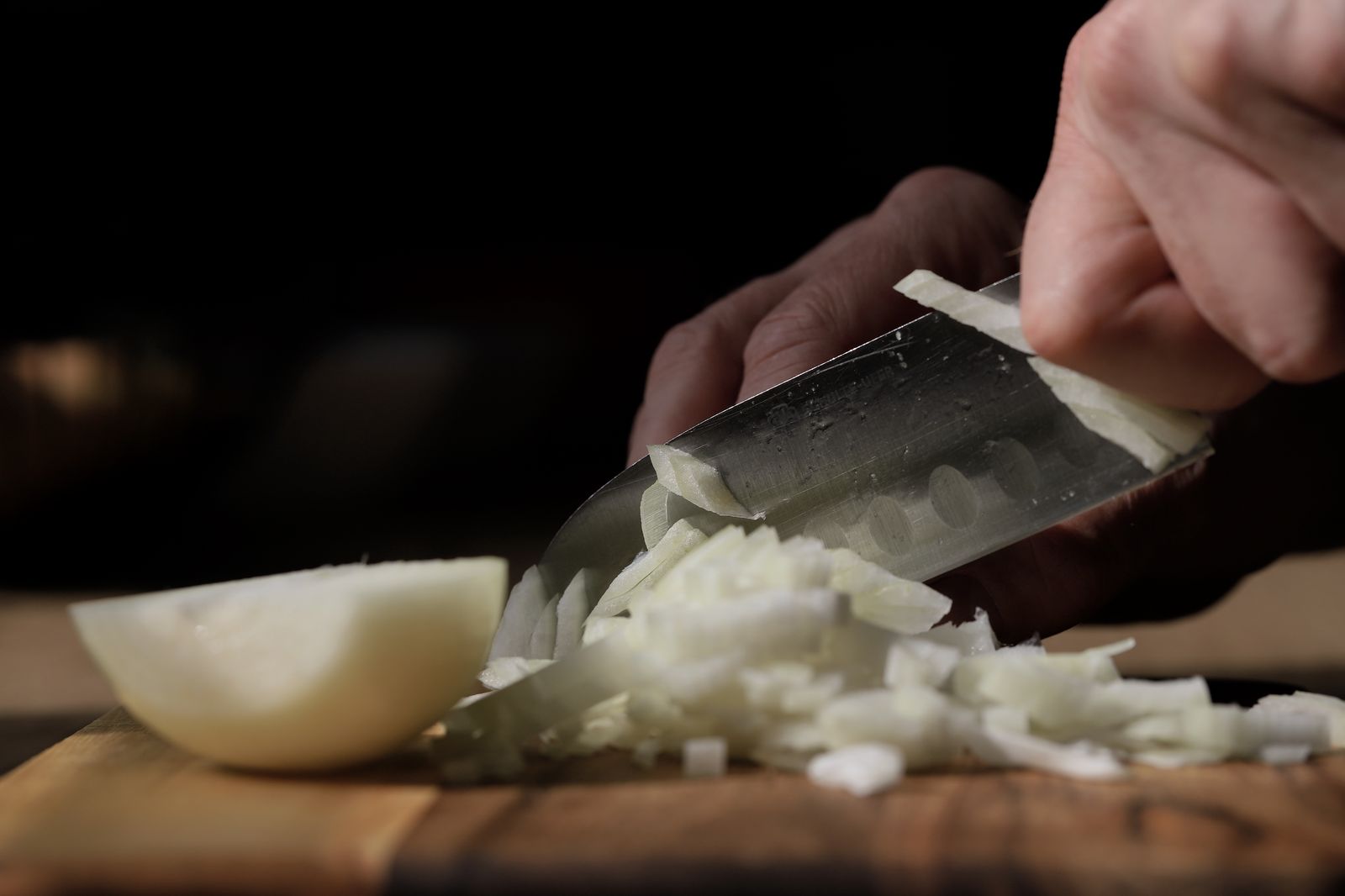
Why Technique Matters: Speed and Safety Are Inseparable
The kitchen adage holds true: 'Slow is smooth, and smooth is fast.' Professional knife work isn't about rushing—it's about repeatable, controlled motions that minimize risk while maximizing efficiency. An improperly held knife and onion invite two problems: fingers in danger and inconsistent pieces that cook unevenly.
The difference between safe, competent cutting and risky fumbling comes down to three fundamentals: hand position, blade sharpness, and the method itself. A sharp knife is demonstrably safer than a dull one, requiring less pressure and giving the cutter better control. When a dull blade demands force, the knife becomes prone to slipping toward the guide hand. A sharp edge bites decisively, leaving no room for accident. Safety note: maintain a sharp blade and use proper grip technique to minimize cut risk during all food preparation.
A sharp knife is demonstrably safer than a dull one—requiring less pressure and giving the cutter better control.
The Foundation: The Claw Grip
The claw grip is the professional standard for protecting fingers while maintaining complete control. The technique sounds counterintuitive—curling the fingers of the guide hand into a claw shape—but it works because the knuckles, not the soft fingertips, become the reference point for the blade.
Form the grip by curling your fingertips inward as if digging them into your palm, and keep a slight arch in the finger joints. Your middle and index knuckles should protrude forward, creating a stable surface the knife blade glides against as you work. This positioning keeps sensitive fingertips away from the blade's path entirely. The guide hand nudges and stabilizes the ingredient while the knuckles act as a rail—the knife side should never venture ahead of them.
The knife grip is equally critical. Choke up on the blade, gripping the heel with the thumb and index finger, allowing the remaining fingers to wrap loosely around the handle. This 'pinch grip' position delivers maximum control and leverage. The blade becomes an extension of a stable hand and wrist, not a separate tool requiring awkward reaches.
Preparing the Onion: The Root-On Method
The root end serves one critical purpose: it holds the onion together while you slice. Remove the stem end (the opposite pole) and trim away the papery skin, but leave the root intact until the final cuts. This structural advantage keeps the onion stable and prevents it from rolling across the board—the first sign of improper technique.
Halve the onion from pole to pole, slicing through the top and stopping at the root. Lay the peeled half flat side down on the cutting board; this creates a stable platform. The flat surface means less rocking and more controlled passes. For the onion to stay put, apply gentle downward pressure with your claw grip hand on top—not to crush, but to anchor.
The cardinal rule: your knife should never move faster than your claw grip can safely retreat.
The Three-Cut Method: Horizontal, Vertical, Cross
Professional onion dicing follows a geometric sequence. Each cut builds on the last, and spacing determines final piece size. For a standard dice (1/4 to 1/2 inch pieces), space cuts roughly 1/4 inch apart; for a fine dice (1/8 to 1/4 inch), halve the spacing.
**Horizontal cuts first:** Hold the knife blade parallel to the cutting board. Make 2–3 passes horizontally from one end toward the root, but do not cut through the root end completely. The blade should stop just shy of breaking through to the board below. These cuts build internal structure; keep the onion half together throughout. Horizontal slices also minimize the release of tear-inducing compounds by controlling cell damage.
**Vertical cuts second:** Once horizontals are complete, make parallel vertical cuts perpendicular to the root. Again, slice from the outer edge toward the root—but stop short. The knife blade should be angled slightly to follow the curve of the onion's layers, not forced through at a rigid 90-degree angle. Stack these cuts close together at your target spacing.
**Cross-cuts third:** After both horizontal and vertical cuts are complete, turn the onion half 90 degrees so the root now points sideways. Make crosswise slices perpendicular to your vertical cuts, letting the knife work through the already-cut segments. The onion will begin to fall apart into individual dice pieces. As you approach the root, move your claw grip hand back carefully to maintain knuckle-to-blade contact. When only the root remains, set it aside—it has finished its job.
Repeat the entire sequence with the second onion half. This assembly-line approach produces uniform dice at professional speed, all from a single method applied consistently.
The Essential Tools: Knife Choice and Maintenance
Knife selection and maintenance determine how much energy the task demands and how safely it goes. An 8-inch chef's knife is the industry standard for onion work—long enough to cut through layers in one smooth motion, heavy enough to let gravity assist the blade, and curved enough to create a rocking rhythm rather than requiring hacking motions.
The blade must be sharp. A dull onion knife doesn't just slow work; it redirects force toward the guide hand, making accidents likelier. Professional kitchens sharpen knives monthly; home cooks should follow the same cadence or whenever the blade no longer bites cleanly through a tomato skin. A sharp knife produces thin, clean cuts; cell damage is minimized, meaning fresher flavor and longer shelf life in prepared ingredients. If you're not confident sharpening by hand, use a professional sharpening service or a honing steel weekly to maintain edge alignment between sharpenings.
Reducing Tears and Maximizing Control
Onion tears are a byproduct of cellular damage—when the blade crushes rather than cuts cleanly, damaged cells release sulfuric compounds that irritate the eyes. Sharpness minimizes this automatically. Additionally, chilling an onion for 15 minutes before cutting slows the release of tear-causing gases, and keeping the root intact until the final cuts preserves the layers that contain the highest concentration of irritants.
Control breaks down when cutting speed exceeds guide-hand safety. The cardinal rule: your knife should never move faster than your claw grip can safely retreat. If you're fumbling or losing position, slow down. Speed is earned through repetition and proper form, not forced. Even professionals occasionally slow their pace to maintain the claw-knuckle-blade relationship.