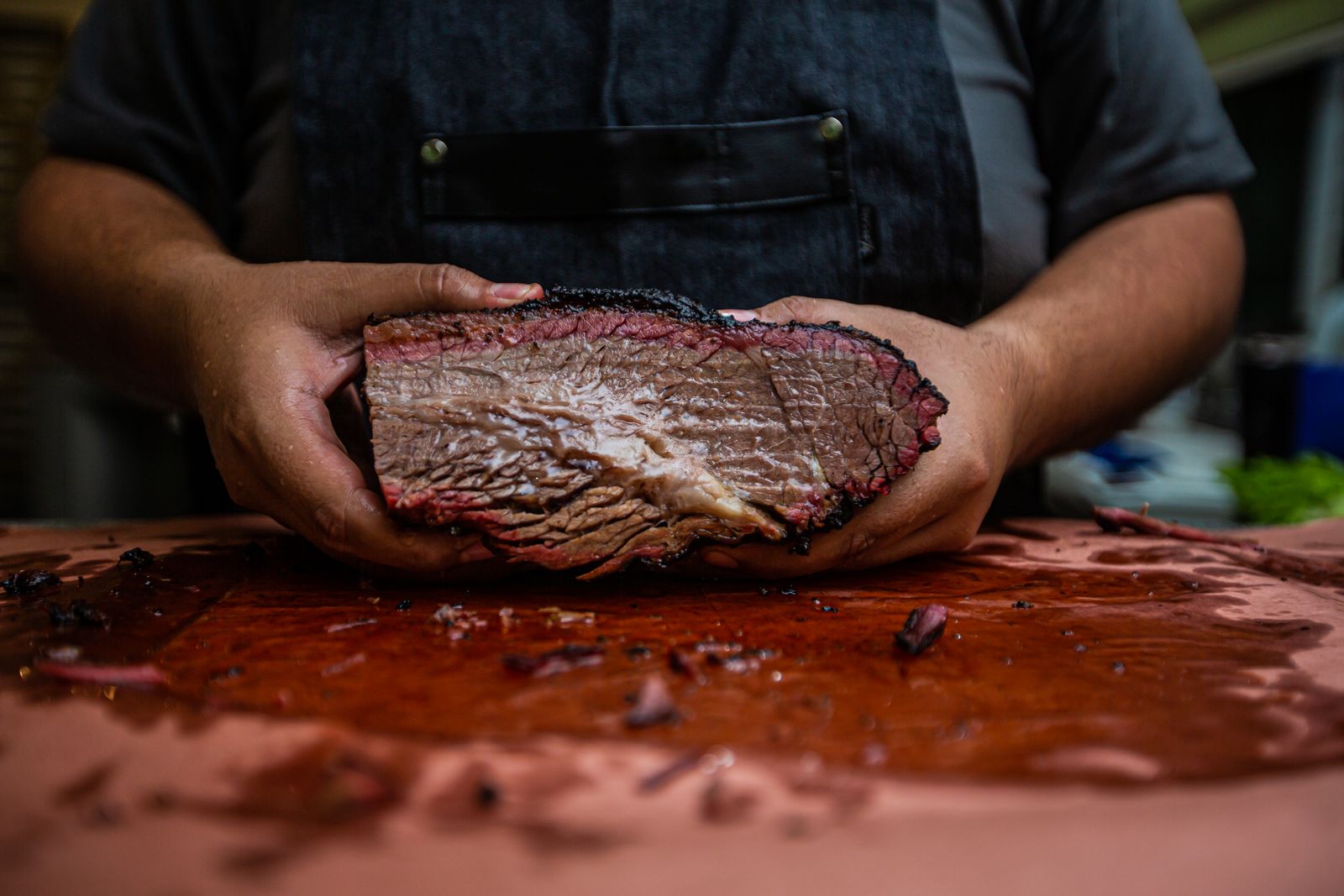
Select and Trim the Meat
Start with a whole packer brisket—the entire primal cut, flat and point intact—weighing 10 to 14 pounds. Look for consistent marbling through the meat and a thick, pale fat cap on top. Trim the top fat to roughly a quarter inch thick. Use a sharp knife to shave away excess, rounding the corners and edges so smoke flows evenly over the surface. Leave enough fat to baste the meat without suffocating the bark. Do not remove the fat entirely; it insulates and moistens the meat during the long cook.
Aim to finish trimming 12 to 24 hours before smoking. This allows the surface to dry slightly, which helps smoke adhesion and bark formation. Store the trimmed brisket uncovered on a rack in the refrigerator.
The Texas Crutch breaks the stall by halting surface evaporation; the meat steams in its own juices, accelerating the push to tenderness.
Season with Salt and Pepper
Apply a dry rub of kosher salt and coarse black pepper. Many Texas pitmasters follow a 50/50 salt-to-pepper ratio—simple, bold, and lets the beef speak. Salt the brisket heavily 12 to 24 hours ahead, applying slightly more to the thicker point end than the flat. This dry-brine period allows salt to penetrate the muscle fibers and enhance moisture retention.
One hour before placing the brisket in the smoker, apply a generous coat of coarse black pepper. Coat all sides evenly. The goal is a dark, peppery crust (the bark) that develops during smoking. Some pitmasters add complexity with a secondary rub—garlic powder, onion powder, paprika—but beef fundamentals demand simplicity first. Avoid sugar-heavy rubs; they burn at low-and-slow temperatures.
Set the Smoker Temperature and Manage the Stall
Set your smoker to 225°F (107°C) as the baseline. Offset smokers (firebox attached to the side) are the Texas standard and provide the most stable, even heat. Place a thermometer at grate level—not at the smoker's dome—to monitor the actual meat zone. Temperature control is the engine of this cook; allow 45 to 60 minutes of cooking time per pound. A 12-pound brisket will require 9 to 12 hours, longer if the smoker runs cool or the brisket is thicker.
Place the brisket on the grate with the thick point end toward the fire and the fat cap facing up. Do not poke the meat with a fork or turn it; let the smoker do the work. Every 20 minutes, check the fire, adjust vents and dampers to hold steady temperature, and monitor the internal temperature.
Around 150°F internal temperature, the meat will hit the stall—a frustrating plateau where temperature stops rising, lasting 5 hours or longer. The cause is not mysterious: evaporative cooling on the meat surface counteracts the smoker's heat. Patience and the Texas Crutch break it.
Probe tenderness—a toothpick sliding through the flat like room-temperature butter—is a more reliable signal of doneness than temperature alone.
Break the Stall with the Texas Crutch
When the brisket reaches 150°F and the bark has set—a dark, ruddy crust visible to the eye—wrap it tightly in butcher paper. Use food-grade, unbleached butcher paper, not foil; it breathes, preserving some bark while trapping steam and moisture. Wrap tight enough that the paper hugs the meat; a loose wrap or leak will cool the meat through evaporation and defeat the crutch.
The Texas Crutch works by halting surface evaporation. The wrapped meat braises and steams in its own juices, accelerating the stall break and typically saving 2 to 4 hours of cooking time. The downside: the bark softens slightly under the wrap. Competitive pitmasters often accept this trade—a juicy interior beats an inedible crust.
Continue cooking the wrapped brisket at the same temperature until the thickest part of the flat reaches 203°F internally. At this temperature, collagen has rendered into gelatin, and the meat is probe tender—a toothpick or probe inserted into the flat slides through with no resistance, like room-temperature butter. Temperature alone is not the final judge; probe tenderness is. Some briskets are tender at 195°F; others require 208°F. The probe test is more reliable than a thermometer reading.
Rest and Slice
Remove the wrapped brisket from the smoker and place it, still wrapped, into an insulated cooler (a basic foam or hard-sided model works). Let it rest for 20 to 45 minutes. This resting phase allows carryover cooking to finish, allows the outer layers to set so they don't tear when sliced, and lets muscle fibers relax and reabsorb moisture. Do not skip the rest; it is as important as the smoke.
Unwrap carefully; steam will escape. Place the brisket on a clean cutting board. Identify the grain direction—two distinct grains run through the brisket, the grain in the flat running one direction and the grain in the point running another. A properly sharpened knife is essential: dull blades tear collagen and create a ragged surface.
Slice against the grain, starting from the flat. Use a long, thin blade and cut slices a quarter inch thick. When you reach the point, rotate the brisket 90 degrees and slice against that grain as well. Serve the slices fat side up, flesh still moist.
Food Safety and Storage
Per the USDA's safe-temperature guidance, beef is safe to eat at an internal temperature of 145°F, rested for three minutes. Most smoked brisket far exceeds this; the 203°F target is driven by texture and tenderness, not safety. The low temperature and long cooking time of this method—12+ hours at 225°F—also eliminate foodborne pathogens through time and temperature.
Refrigerate leftover brisket within two hours of cooking. Properly stored, wrapped in foil or a sealed container, brisket keeps 3 to 4 days under refrigeration or 3 months frozen. Rewarm gently at 275°F until it reaches 165°F internally.