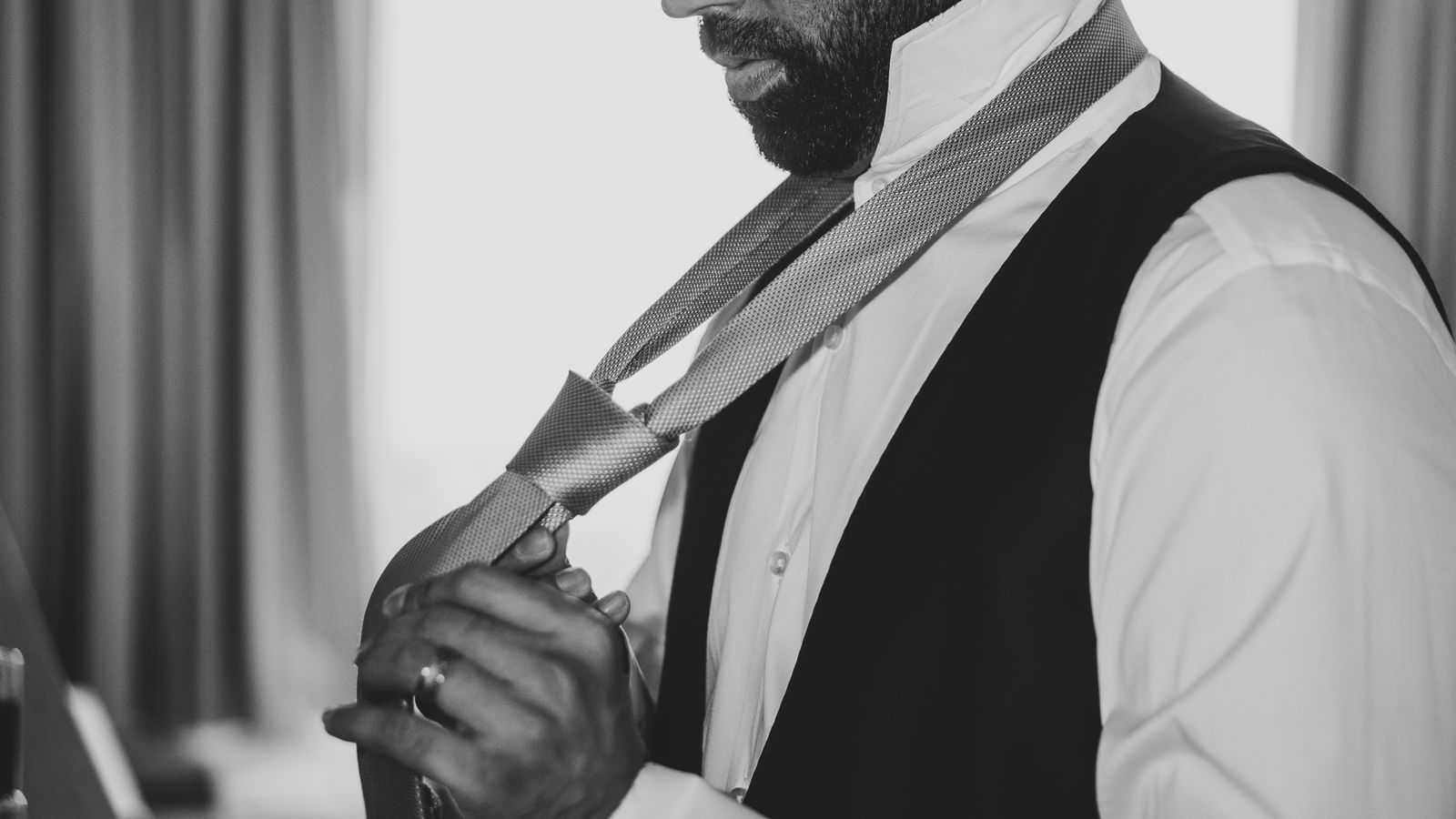
Why Tie Knots Matter
A necktie knot is not incidental. It's the focal point of a man's dress ensemble, the visual anchor that directs attention to the face and neckline. According to Gentleman's Gazette's research on collar pairing, the outside border of the tie knot should correspond precisely with the inside border of the collar—creating visual balance. A poorly knotted or mismatched tie broadcasts indifference; a deliberate one signals competence.
The science behind tie knots is more rigorous than most men realize. Researchers at the University of Cambridge, Thomas Fink and Yong Mao, developed a mathematical language to describe all possible tying actions and calculated that there are exactly 85 classically-formed necktie knots, with extensions to that research suggesting over 177,000 theoretical variations. Yet for daily wear, four knots handle nearly every situation a man will encounter.
The outside border of the tie knot should correspond with the inside border of your collar.
The Four-in-Hand: The Workhorse
The Four-in-Hand is the reigning champion of necktie knots. Named after a 19th-century gentleman's club, it is asymmetrical, slender, and tapered—characteristics that make it the most versatile knot in a man's repertoire. Per Ties.com's specifications, the Four-in-Hand rates 2/5 for size, 3/5 for symmetry, and 1/5 for difficulty, meaning it's quick to master and works with virtually any tie fabric.
**How to Tie the Four-in-Hand:**
1. Drape the tie around your neck with the wide end on the right, extending approximately 12 inches below the narrow end on the left.
2. Cross the wide end over the narrow end toward the left.
3. Bring the wide end under the narrow end to the right.
4. Cross the wide end over the front toward the left.
5. Pull the wide end up through the neck loop from underneath.
6. Hold the front of the knot loosely with your index finger, then pass the wide end down through the loop you've created in front.
7. Tighten by pulling the narrow end and sliding the knot up to your collar.
The Four-in-Hand pairs excellently with button-down collars and forward-point collars. Gentleman's Gazette notes it's particularly effective with thicker knit ties, where other knots would appear oversized. The knot is also self-releasing—loosen the narrow end and the knot unwinds without catching.
The Half-Windsor: Balanced Formality
The Half-Windsor occupies the middle ground between the slender Four-in-Hand and the substantial Full Windsor. It produces a symmetrical, triangular knot that works with medium to light-thickness ties and suits almost any collar type except the narrowest cuts. Per Ties.com's technical breakdown, the Half-Windsor creates a deep dimple and is appropriate for all occasions.
**How to Tie the Half-Windsor:**
1. Start with the wide end on the right and the narrow end on the left. The narrow end should rest slightly above your belt buckle.
2. Cross the wide end over the narrow end to the left, then under and to the right.
3. Pull the wide end up toward the neck loop, then pass it through from underneath.
4. Bring the wide end across the front to the right.
5. Pull the wide end up through the neck loop from underneath once more.
6. Pass the wide end down through the loop you've created in front.
7. Tighten by pulling down on the wide end and sliding the knot up to your collar.
The Half-Windsor is particularly effective with spread collars, which accommodate its fuller shape without the knot looking crammed. Its balanced proportions make it the default choice for job interviews and client-facing business.
The Full Windsor: Maximum Impact
The Full Windsor is the largest and most symmetrical of the four knots. It creates a prominent triangular shape that demands space and confidence. According to Ties.com, the Full Windsor achieves a perfect 5/5 symmetry rating and is ideal for formal occasions—weddings, black-tie events, or situations requiring visual authority. It pairs best with spread collars (French collars) and cutaway collars.
**How to Tie the Full Windsor:**
1. Position the tie around your neck with the wide end on the right, draping near your belly button.
2. Cross the wide end over the narrow end to the left.
3. Pull the wide end up through the neck loop from underneath, then pull it down on the left side.
4. Bring the wide end around the back of the narrow end to the right.
5. Pull the wide end up through the neck loop again, this time to the center.
6. Pass the wide end across the front of the knot to the left.
7. Pull the wide end up through the neck loop from underneath once more.
8. Pass the wide end down through the loop created in front.
9. Tighten by pulling the narrow end and sliding the knot up.
The Full Windsor consumes more fabric than other knots, which is why Gentleman's Gazette warns against pairing it with button-down collars—the knot becomes visually oversized and appears cramped. Tall men benefit from its bulk; shorter men may find it overwhelms the neckline.
A dimple gives the tie dimension and creates a three-dimensional sense—without it, a tie looks loose, flat, and even a bit sloppy.
The Pratt: The Modern Alternative
The Pratt knot—also called the Shelby knot—was invented by Jerry Pratt, a U.S. Chamber of Commerce employee who wore the same knot for 30 years before television anchor Don Shelby popularized it in 1989. The Pratt is wider than a Four-in-Hand but narrower than a Windsor, making it an excellent middle option for men who want symmetry without bulk.
**How to Tie the Pratt:**
1. Start with the tie inside out (seam facing outward), wide end on the right, extending about 12 inches below the narrow end on the left.
2. Cross the wide end under the narrow end.
3. Bring the wide end up, over, and back under the narrow end.
4. Pull up through the neck loop and tighten slightly.
5. Cross the wide end over to the right.
6. Pull the wide end up and behind the neck loop.
7. Pass the wide end down through the loop in front.
8. Tighten by squeezing both sides of the knot at the base—this creates the dimple. Pull the narrow end to secure.
The Pratt works with medium to slightly thicker ties and is suitable for business settings, casual dress, and cocktail occasions. Its versatility makes it a reliable standby.
The Dimple: The Finishing Detail
A dimple—the small vertical indentation below the knot—separates a well-dressed man from one who merely wears a tie. Per Gentleman's Gazette's dimple guide, the dimple gives the knot dimension and a three-dimensional quality. Without it, even a correctly tied knot looks loose, flat, and sloppy.
**How to Create a Dimple:**
When you reach the final step of tying any knot, before threading the wide end through the front loop, reach in with your thumb and forefinger and create a small gap at the center of the knot. Hold this gap while pulling the wide end through gently. The fabric naturally folds inward, creating the dimple. Alternatively, you can pinch the edges of the tie just above the knot as you tighten, squeezing both sides together while pulling the wide end down—this technique produces a more pronounced dimple and works particularly well with the Pratt and Half-Windsor.
For a side dimple (slightly off-center), create the fold on your preferred side before threading the wide end through. The dimple is not decoration; it's the signature of intentionality.
Collar and Knot Pairing Guide
The most common error is mismatching knot size to collar spread. A knot that's too large for a narrow collar appears stuffed and unstable; one that's too small for a wide collar leaves awkward empty space on either side.
**Button-Down Collars** work best with the Four-in-Hand. The collar points curve down and inward, accommodating a smaller knot. Pair button-downs with larger knots and the result is visually jarring.
**Forward-Point (Standard) Collars** are versatile and pair well with the Four-in-Hand and Half-Windsor. The straight, forward-facing points accept knots ranging from small to medium without difficulty.
**Spread Collars** (and the wider French/Cutaway variants) are designed for larger knots. The Half-Windsor and Full Windsor fit these collars ideally—the knot fills the space between the collar points without excess fabric showing on either side. Gentleman's Gazette's pairing research emphasizes that proper proportion makes the tie knot appear intentional rather than accidental.