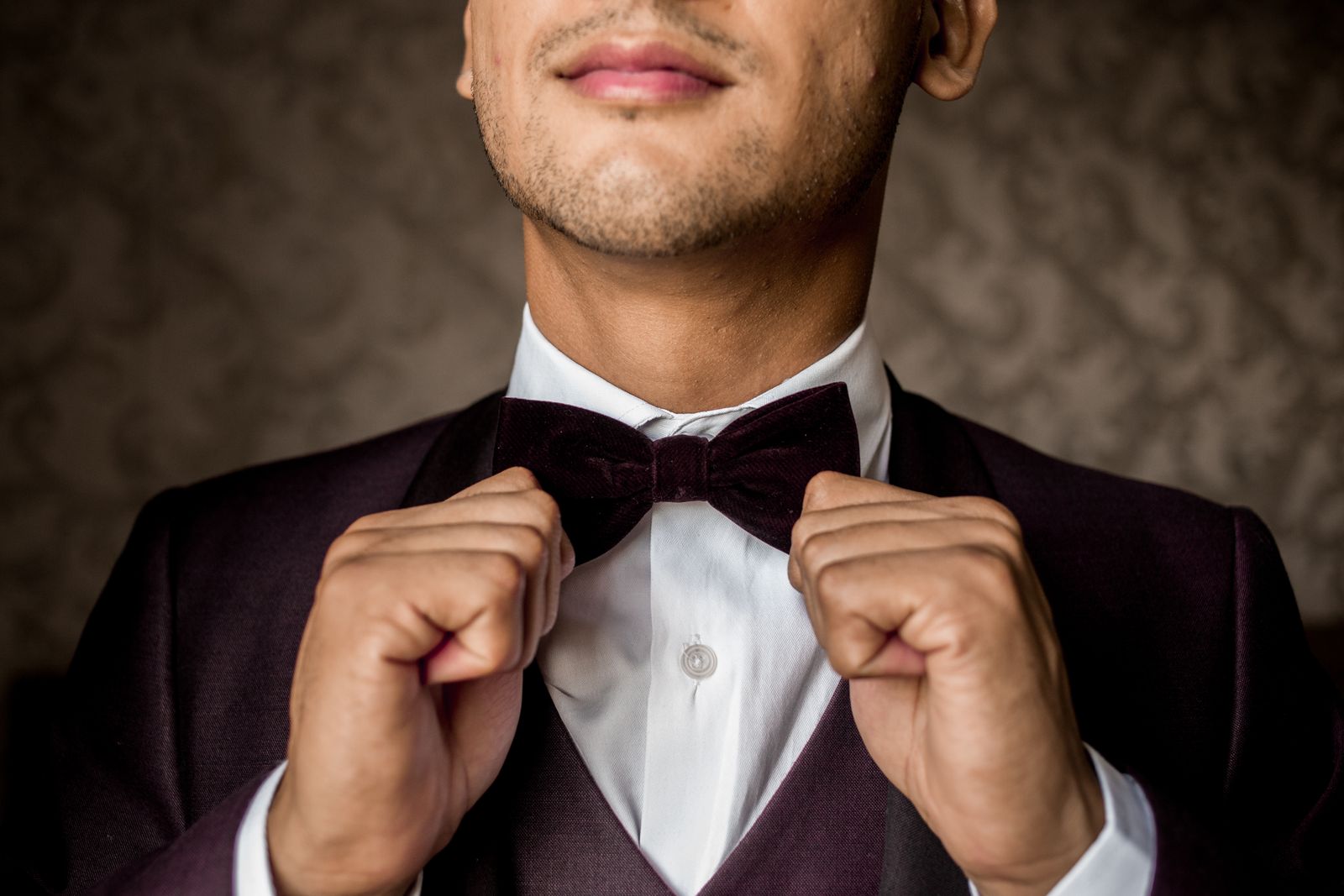
Why the Bow Tie Demands Respect
A bow tie is not merely decorative; it's a statement of formality and deliberation. Unlike a four-in-hand necktie, which drapes passively from the neck, a self-tied bow tie demands active participation—it must be knotted each time it's worn, signaling intentionality. The bow tie originated with Croatian mercenaries during the Thirty Years' War, who wrapped scarves around their necks to hold their shirts together. This utilitarian cord evolved into the French cravat and, eventually, the modern bow tie.
According to Gentleman's Gazette's formal-wear analysis, the bow tie is the necktie of choice for black-tie, white-tie, and black-tie optional events. It signals respect for the dress code and the occasion. As one menswear authority notes, wearing a bow tie demonstrates "an aggressive lack of concern for what other people think"—which is precisely why it conveys confidence. A properly tied self-tie bow tie is indisputably more elegant and formal than a pre-tied bow tie, which relies on a clip or snap fastener hidden beneath the collar.
A properly tied self-tie bow tie is indisputably more elegant and formal than a pre-tied bow tie.
Self-Tie Versus Pre-Tied: The Distinction That Matters
The self-tie bow tie—also called a hand-tied or band bow tie—is a length of fabric approximately 52 to 54 inches long that wraps around the neck and ties with a shoelace knot. The pre-tied bow tie, by contrast, arrives pre-formed and snaps or clips to the wearer's collar, requiring no knot-tying skill.
For formal occasions, etiquette strongly favors the self-tie. Gentleman's Gazette's black-tie guide emphasizes that self-tied bows are "generally considered to be more elegant and formal than a pre-tied bow tie." Black-tie and white-tie dress codes explicitly call for self-tied bows; a pre-tied bow at such an event signals either ignorance of the dress code or unwillingness to make the effort. A pre-tied bow is acceptable for business casual, cocktail attire, or informal occasions, but for any event specified as formal or black-tie, the self-tie is the only appropriate choice.
The self-tie also allows for personal adjustment—the wearer can control the exact dimensions of the loops and the overall width of the knot. A pre-tied bow is fixed and cannot be tailored to one's neck width or personal preference.
Bow Tie Sizing and Fit
Sizing is determined by neck circumference, not height or general build. A bow tie should sit snugly around the neck with room for only one to two fingers inserted underneath. A bow tie that is too loose will slide around and appear sloppy; one that is too tight will choke and distort the finished knot.
Standard bow ties are manufactured to match standard shirt collar sizes. A man with a 15-inch collar typically needs a size 15 bow tie. Oversized or tall men should opt for larger bow ties—a 16.5- or 17-inch size. Men with smaller frames may need smaller sizes, down to 14 inches. The only way to know your correct size is to measure your neck circumference at the widest point, at the base of the collar, and then purchase a bow tie corresponding to that measurement.
Bow ties come in two primary shapes: the bat-wing (parallel-sided), which is sleek and formal, and the butterfly (thistle) shape, which is wider and more visually prominent. For black-tie and formal occasions, the bat-wing is preferred. The butterfly is more flexible and works across business casual and semi-formal settings. A self-tie bow tie should be made from silk, which holds a knot without excessive wrinkles, or a silk-polyester blend for durability. Wool and cotton are less common and less refined for formal wear.
How to Tie a Bow Tie: Eight Steps
The self-tied bow knot is fundamentally a shoelace knot—the same knot used to tie shoes, executed at neck height with neckwear fabric instead of shoe laces.
**Step 1: Position the fabric.** Drape the bow tie around your neck with both ends hanging down. The non-dominant side (left side for a right-handed man) should hang approximately 1.5 to 2 inches longer than the dominant side. Cross the longer end over the shorter end.
**Step 2: Wrap and adjust.** Pull the longer end around the back of the shorter end, threading it up through the neck loop, then back to the front so both sides hang evenly at the same length. This is the base wrap, and both ends should now hang at equal height.
**Step 3: Form the first loop.** Fold the end on your dominant side up and back over your shoulder, creating a loop. This loop will become one half of the finished bow.
**Step 4: Bring the second end over.** Take the remaining end on the non-dominant side and bring it across the front of the loop and the protruding end, creating a crisscross.
**Step 5: Fold the second end.** Fold the second end back on itself to create a second loop that mirrors the first. You should now have two loops and two protruding ends.
**Step 6: Thread through the hole.** Hold both loops together at their base with one hand. With your other hand, feed the second loop through the hole created at the center of the knot. This threading action tightens the bow and locks the knot in place.
**Step 7: Tighten and adjust.** Pull both loops firmly but gently to tighten the knot. The two loops should be symmetrical and sit squarely at your neck.
**Step 8: Final positioning.** Fold down your dress shirt collar so it sits properly over the top of the bow tie. The bow tie should rest against the collar points, not beneath them. Adjust the loops and the center knot until the bow appears level and balanced.
Wearing a bow tie demonstrates an aggressive lack of concern for what other people think—which is precisely why it conveys confidence.
Bow Tie Specifications and Dimensions
Understanding the technical dimensions of a properly tied bow tie helps ensure consistency and formal correctness.
**Standard tie length**: 52–54 inches (unwrapped). Some manufacturers produce extended lengths for tall men; measure your neck and select accordingly.
**Bat-wing shape**: 2–2.5 inches wide; parallel sides; most formal and slenderizing; best for black-tie and white-tie.
**Butterfly shape**: 2.5–3.5 inches wide; wider at the center, narrower at the points; more visual presence; suitable for business and semi-formal.
**Neck fit**: Snug with one to two fingers of clearance; size determined by neck measurement, not height.
**Loop dimensions when tied**: Approximately 2 inches wide and 1.5 inches deep; symmetrical and level with the neck.
**Proper neckline position**: The bow tie knot should rest at or just below the collar points of your dress shirt, not floating above the collar or buried beneath it.
Pairing a Bow Tie With a Tuxedo
A bow tie and tuxedo are inseparable for black-tie events. The tuxedo is defined by its formal lapels and satin accents; the bow tie is the necktie of choice.
For a standard black-tie event, select a black silk bow tie in the bat-wing shape. Black coordinates with the tuxedo's black jacket and trousers and maintains visual unity. The silk finish complements the satin lapels and cummerbund.
For a black-tie optional event where you choose to wear a tuxedo, a black bow tie remains the safest choice, though a dark navy or even a subtle pattern (small dots or stripes in black and white) is acceptable. Avoid bright colors or thick patterns; they diminish the tuxedo's formality.
For white-tie (the most formal dress code), a white silk bow tie is mandatory. It pairs with a white piqué waistcoat and a white dress shirt with a wing collar. White-tie allows no deviation; the bow tie must be white.
Pair your bow tie with a formal dress shirt featuring a wing collar, spread collar, or forward-point collar—never a button-down collar, which is too casual for black-tie. The collar points should frame the bow tie knot. Your dress shirt must be white for white-tie and black-tie; for black-tie optional, a white or cream shirt works, but white is more formal.
Wear a cummerbund or waistcoat in black or coordinating dark color. The cummerbund or waistcoat hides the trouser waistband and completes the formal silhouette. Ensure your jacket is single-breasted with satin-faced lapels and that your trousers have a side satin stripe. A well-knotted bow tie sets off the entire ensemble.
Common Mistakes and How to Fix Them
The most common error in bow-tie tying is incorrect sizing. If your bow tie is too large for your neck, the loops will be oversized and the knot will not sit properly. If it is too small, the loops will be cramped and the knot will look pinched. Always measure your neck first and purchase the correct size.
A second mistake is failing to wrap the initial base knot correctly. The foundation wrap—step 2 above—must be tight and even, with both ends hanging at the same length after threading through the neck loop. If this base is uneven, the finished bow will be asymmetrical.
A third error is pulling too hard when tightening the loops. Gentle, firm pressure is required. Yanking on the loops can tear the fabric or distort the knot beyond repair. If your bow tie does not look right, start over rather than attempting to force it into shape.
If your bow tie repeatedly appears uneven, practice in front of a mirror with deliberate, slow movements. The knot requires muscle memory; tie it several times in succession until the steps become automatic. After a dozen tied bows, most men report that the process becomes fluid.
Self-Tie Versus Pre-Tied and When Each Is Appropriate
The choice between self-tie and pre-tied depends on the formality of the event and the dress code specified.
**For black-tie and white-tie events**: Self-tie is mandatory. Pre-tied bows are explicitly considered incorrect for formal events.
**For black-tie optional**: If you wear a tuxedo, choose self-tie. If you wear a suit, a pre-tied bow tie is acceptable.
**For business and cocktail attire**: Pre-tied bows are appropriate and far more practical for daily wear. They save time and ensure a consistent appearance.
**For informal and casual settings**: Pre-tied bows are fine; self-tie is unnecessary.
If you attend even one black-tie event per year, learning to tie a bow tie is worth the investment. The skill takes less than two weeks to master and signals respect for the occasion. A man who can tie his own bow tie is perceived as more formal, more attentive, and more confident than one relying on a pre-tied substitute.